Showing posts with label Performance Reviews. Show all posts

Thursday, October 7, 2010

The Template of Homo Cubiculum

When I posted the comments about performance appraisal the last time around, I hinted at the uselessness of the practice from the point of view of well established scientific principles and some torch bearers of the process world.

However, as Nicholas Taleb will no doubt underline with his unapologetic pen, business and corporate world are not supposed to follow the way that science dictates is optimal. Genetically, human beings are not equipped to be rational when it comes to questions involving highest of stakes. I have reasoned in my past post that however harmful performance evaluations are, we will continue to take part in them.
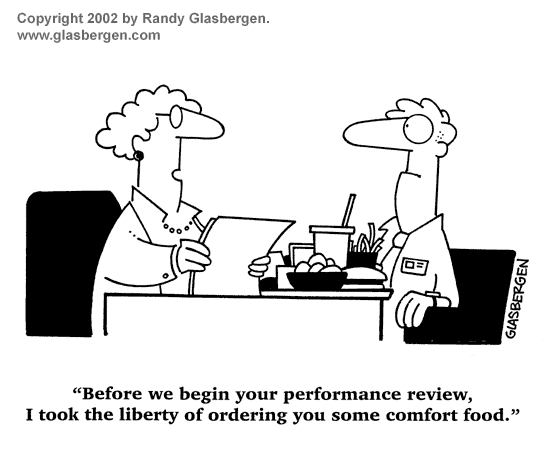
So, having accepted the phenomenon as an unnecessary but existing evil, let us look at the populace who has to deal with the same. Since it is the unholy grail of employed existence, the lives of the  cubicle creatures tend to revolve around the evil event. The commitment, big picture, customer focus, vision and mission, synergy and strategy, and the entire juggernaut of jargon are little more than useless Lego pieces used to fill up the infinite minutes that one has to spend in meeting rooms. The focus remains unwaveringly on the rating sheet, and the corresponding infinitesimal increase in increment over others, that fraction of an inch gained in the contemptible climb along the corporate ladder.

However, it has been my observation, that in this regard, people approach the pitiable podium in different ways –  basing their habits on the ancient  ways of livelihood of human being.

The first group of employees approach it as did the hunter gatherers of yore … who lazed and lolled about most of the day, before reacting to the pangs of hunger to be stirred into violent action. Some of them clubbed down their prey when required, with primitive lack of subtlety or sophistication. And others took some more time in preparing the snare that would trap an unsuspecting meal into the guile and then guts of ingenuity.
This is the group that depends upon the activities of the last few weeks, the feverish collection of accolades during the last month – and a calculated siesta for the rest of the period under evaluation. Evolution has taught their not so active mental mechanism that public memory is fickle, the immediate impressions are stark, and the rewards require to be reaped before they fade away.
However, as the hunter gatherer ancestors had to depend on fortunes to ensure the presence of edible meat in their vicinity when the stomach demanded restoration, these corporate creatures have to depend on the uncertain chance of there being a façade during the home stretch on which they can etch their grubby paw marks.

The second group prefer the way of the farmer. They sow their seeds and irrigate throughout the year, as and when season is favourable, adding fertilisers of different degrees and fluidity according to events and ethics, and wait to harvest the resulting returns of cash crops. Often backbreaking, their stolid agricultural pursuits are also dependent on elements of chance. Rains and sunshine, the right kind of fertilisers, hunters and gatherers chasing their quarry across the carefully ploughed field, messing up the harvest just when it is ripe.

The Indian contingent in my workplace constitute another variety of ancient templates made mundanely modern. The nomads. They roam from place to place, living off the fat of the land as long as provisions last, as long as the residents don't chase them away, as long as the caravan is capable of taking them to the next port of call. The home left behind, in this case, does not really matter in terms of wildlife to chase, fertilisers to apply or cash crops to reap. They are closer to the places they visit, striking up rewarding relationships with the residents on site.

The deviant of the nomads are also based on image of the old ancestors, the emissaries of the monarch back home, loyality stamped on lips, zealously planting flags across horizons, claiming each well trodden stretch of land to be the New World. They are the account manager types, brandishing the coat of arms – the shining laminated MBA degree, in a bid to strike up alliances.

And then there is the independent contractor – the mercenary, the ronin. One who fends for himself and is detached. Who is a free soul, not too worried about the grail as long as he can loot his booty in the crusades.

Of course, in the dark corners of the cubicle, in the quest for the eternal rating, there crops up another profession – older than the most ancient. Where exceeding expectations of the supervisor takes on a whole new perspective. However, let us pretend that everything is squeaky clean and look the other way, one of the most frequent and followed best practices that can be picked up from corporate culture.

Sunday, September 26, 2010

Performance Reviews - The Third Sin - The Most Harmful of Corporate Practices

Come September, there is a sociological season change in my workplace. My buddy calls it the coming of the harvest months.

There is a purpose in the people, a spring in their steps … and if one follows them with time lapse photography or other devices of National Geographic film makers, one can detect a certain direction not only in their work, but also in their walk. This is the period when members of the client organisation is accosted with ingratiating smiles, eminently avoidable small talk and finally a prepared and mailed across feedback form that needs affirming stamp of approval.

These appreciation mails, earned through coax and cajole, with the most mundane of endeavours made out to be pioneering achievements, are virtually worn by the staff, in their newest gloss, repetitions, bulletins and forwards underlining emphasis, until these recommendations bear fruit in the form of a decent annual performance review, a fractional increase in the acceleration across the steep corporate ladder. Feats celebrated with relentless drinking  and happy hangovers – post harvest festivities according to my esteemed buddy.

Professor of the UCLA School of Management and the co-author of Get Rid of Performance Reviews, Samuel Culbert, argues that Performance Reviews contribute little positive and many negatives in an organisation. Among others, the axiomatic practice damages the relationship between bosses and their subordinates, keeps employees from speaking honestly about themselves and company practices, helps bad managers be bad managers and hinders good managers from being good managers, and ultimately hurts the bottom line. He also adds that there isn't a shred of evidence that anything good came out of this practice.

Whereas Professor Culbert’s arguments can be taken with the pinch of salt necessitated by the modern trend of management teachers in voicing the radical, there is a robust and, to me, irrefutable support from the celebrated quarters of Dr. Edward Deming who regards Performance Reviews as one of the Seven Deadly Sins of Management. In his epoch making book, Out of Crisis, Deming unequivocatingly states the downsides of the merit review process as he saw it. The idea of a merit rating is alluring. the sound of the words captivates the imagination: pay for what you get; get what you pay for; motivate people to do their best, for their own good. The effect is exactly the opposite of what the words promise. In fact, he listed Performance Reviews as one of the seven deadly sins of management. However, like most of the other sins against which his astute mind warned, this practice is continued by corporations to this day.

Not mincing his words, Dr. Deming further added - The performance appraisal nourishes short-term performance, annihilates long-term planning, builds fear, demolishes teamwork, nourishes rivalry and politics… it leaves people bitter, crushed, bruised, battered, desolate, despondent, dejected, feeling inferior, some even depressed, unfit for work for weeks after receipt of rating, unable to comprehend why they are inferior. It is unfair, as it ascribes to the people in a group differences that may be caused totally by the system that they work in.

Among the studies which have largely agreed with his findings, in my mind, the most fascinating is the one which shows that the best predictor of the current year’s performance rating is – the last year’s rating.  This is mainly due to the couple of reasons – impressions created by employees during the initial period in the company generally continue throughout their tenure, and the trend of same companies to hand good ratings by rotation.

Culbert further adds - The performance review, a practice that is as destructive and fraudulent as it is ubiquitous. Despite all the evidence — despite the fact that almost every person reviewed and every person reviewing knows it is bogus — corporate bosses do nothing to hasten its demise. They won't even acknowledge they have a problem. Performance reviews, in which bosses look for weaknesses and pretend to speak objectively for the company, while subordinates grin and bear it, misapply the hierarchical structure that is necessary in any organization. They ensure that the relationship is about power and subordination, making candour all but impossible, and defensiveness the behaviour of choice for stressed employees.

The possibly robust derivative of this phenomenon – the three hundred and sixty degree appraisal in which an employee is appraised by his superiors, peers and subordinates – is something experimented with very gingerly by some select corporate organisations, preferring to perch on the comfortable fence and wait till it becomes one of the undeniable norms of the employer of choice.

Why do corporations continue with this trait? Why do leaders they say they want candour in the workplace, but refuse to change the most obvious impediment to such truth telling? And why do they uncritically accept the notion that there is but one truth — the manager's?

Culbert says that this can be attributed to intellectual laziness to bring in alternative solutions, the leadership ego, the reservation to being proved wrong in front of peers and subordinates and unwillingness to fix internal processes.  The looming performance review protects the manager from dealing with how subordinates really feel. It’s like an anaesthetic: The unhappiness and anger is still there, but the manager doesn’t have to feel a thing.

This view, according to me, is a bit harsh on the managers. There is indeed a definite degree of truth in the fact that managers like the authority, to use much utilised terms like attitude problem and insubordination to subdue a threatening junior. However, it can also be attributed to the fact that reward and recognition is so intricately woven into our social interactions, that we cannot contemplate work without review. It is not only the manager, but also the employee who is equally at a loss here to supply a change.


Well, Culbert does promote the performance preview method.
Deming offers his method of educated leadership, responsible hiring, training and education, lengthy constructive discussions and focusing on quality. There are also other ideas and opinions which suggest ways and means to implement processes les ridiculous.

However, in a culture where people continually focus on the next three months, organisations whose human resources themselves flow about in the constant waves of attrition, where the absolute management focus is on the bottom line, next quarter and valued clients, the recruitment strategy based on immediate hires to fit burning requirements promised to the client, the corporation an organism with psychopathic character traits, the sole guiding factor for which is the returns, who will be providing the necessary thought leadership to ensure a change of process that itself is a paradigm shift across the corporate world?

Simon van der Wiel is a fictitious character who appears in the novel The Best Seller by Arunabha Sengupta.

These lines are both collected from the novel and extrapolated from it - additional musings of the author through his alter ego


About Simon

My photo
Amsterdam, Netherlands